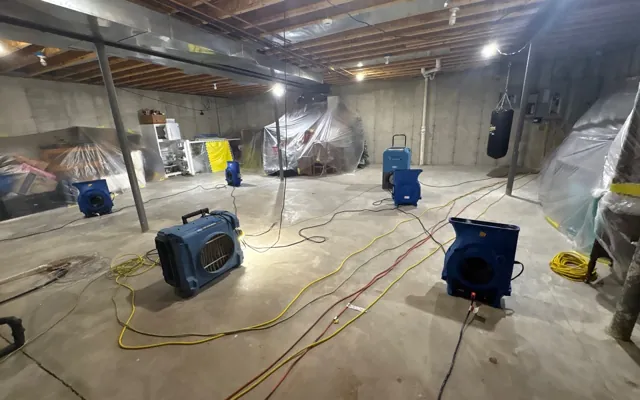
Water pooling in a below-grade room, cellar, or sunken level? These spaces are rare in Rancho Cucamonga, so drying them right takes local know-how. The IICRC-standard crew responds in about an hour, day or night.

Crews measure the water, identify whether the source is storm intrusion or a plumbing failure, and deploy pumps and extractors to clear standing water quickly.
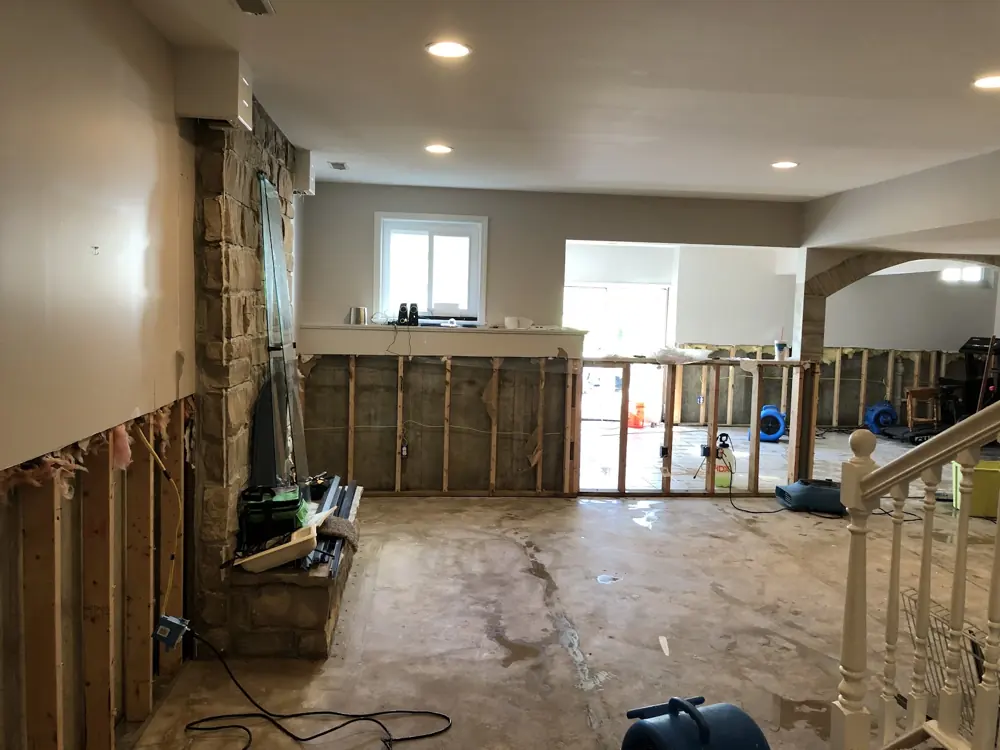
Soaked carpet, baseboards, and the lower band of drywall are removed so the structure behind them can dry instead of trapping moisture.
Dehumidifiers and air movers run in the enclosed space while crews track moisture in the slab and framing daily until it meets a dry standard.
Crews rebuild drywall and trim, treat surfaces against mold, and advise on grading or drainage fixes so the low area stays dry.

While help is on the way, these first steps, done only where it is safe, limit the damage and protect the insurance claim.
Shut the supply off at the source, or close the home's main valve if the source is not obvious. Stopping the flow limits the damage more than anything else.
Switch off electricity to the affected area, but only if the breaker can be reached without standing in or touching the water.
Get a crew dispatched right away. The sooner extraction and drying begin, the more flooring, drywall, and belongings can be saved.
Take photos and a short video of the water and the affected rooms before anything is moved, so the insurance claim starts strong.
Cleanup for a flooded below-grade room in Rancho Cucamonga generally costs $2,000 to $7,500, depending on how much water entered, how long it sat, and how much finished material must be removed and rebuilt. Contaminated water raises the total. When the cause is sudden, such as a burst pipe or storm intrusion, homeowner's insurance usually applies. Crews hold major repairs pending adjuster approval and bill the carrier directly.
Crews reach Rancho Cucamonga and the Inland Empire fast, from Alta Loma and Cucamonga to Etiwanda, plus nearby Upland, Ontario, Fontana, and Montclair. See the full list on the areas served across Rancho Cucamonga page.
See all areas servedEvery loss is photographed, measured, and logged from the first visit, so the paperwork holds up with your insurance carrier.
Technicians follow recognized IICRC drying standards and prove the work with daily moisture readings, not guesswork.
Emergency dispatch any hour of the day or night, with a real crew on the way, not a callback in the morning.
A real crew dispatched any hour, not a callback in the morning.
Trained technicians following recognized IICRC drying standards.
Truck-mounted, portable, and submersible for any size loss.
The loss is documented and billed to the carrier directly.
Very few do. The area is almost entirely slab-on-grade, so most flooding crews see in low spaces involves partial cellars under older homes, sunken rooms, wine cellars, or below-grade garages. Crews treat any enclosed low area the same way: rapid extraction followed by controlled drying and monitoring.
Most enclosed low spaces dry in five to eight days once water is removed. Slab, framing, and drywall hold moisture that must evaporate under controlled airflow. Crews run dehumidifiers and air movers continuously and confirm with moisture meters before crews call the space dry.
It depends on the source. Clean water from a supply line is low risk at first, but storm runoff or sewage backup is contaminated and needs protective handling and disinfection. Standing water of any kind grows bacteria over time, so crews test the category and treat the space accordingly.
Sudden causes like a burst pipe, a failed water heater, or a storm intrusion are typically covered by homeowner's policies. Gradual seepage or long-neglected drainage is often excluded. Crews document the cause and moisture data so your adjuster has what the claim needs.
Rancho Cucamonga crews are on call 24 hours a day, local and fast, and can be on the way within the hour.
Call (909) 442-0503